
Hot and Cold
an ode to women’s work

“Women’s work” is on Broadway with a vengeance.
This month, I saw two domestic acts onstage that shattered me. In one play, a woman unfolds a pull-out couch so her terminally ill son can occupy her bedroom. In another, a woman churns butter with an unwavering, “reclaiming-my-time” fury that swells to fill the theater. Neither act is “the main point” of the scene, which ironically is the point: both plays draw attention to the invisible labor performed by women.
In this piece, I write about two plays created by women and featuring primarily female casts: Mary Jane and The Welkin. In my writing, I do not wish to make essentialist arguments about “men” and “women.” I believe that gender is a construct and do not want to reinforce gender binaries or stereotypes. However, I think it is imperative to highlight why this kind of provocative, incendiary theater only could have been made by women or by other marginalized groups… and why it is so important to support this kind of theater.
When I experience art made by women, I often detect traces of guerilla warfare. I detect an efficiency borne out of the need to get a word in edgewise— and to make that word count. I detect an elegant economy, a tautness, that speaks volumes about a woman’s lived experience in a man’s world. Women can write whatever kind of play they damn well please, but certain plays (like Mary Jane and The Welkin) make me proud to be a woman; relieved to bear witness to the genius of a woman’s mind and perspective.
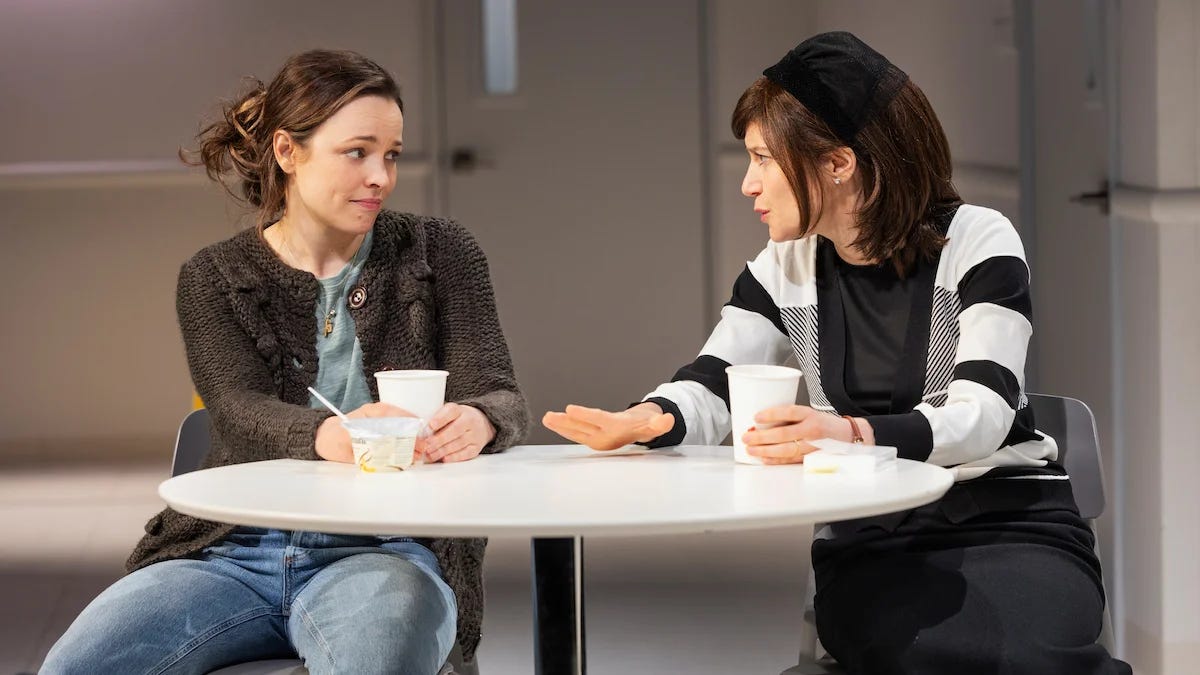
Mary Jane (written by Amy Herzog and directed by Anne Kauffman) is a story about a woman (played by the sublime Rachel McAdams) caring for her chronically ill son. McAdams’s Mary Jane is what one reviewer called “the embodiment of apologizing for living”: calm, resilient, and highly attuned to the needs of others even in her own distress.
Mary Jane is a very different kind of hero than those portrayed in Marvel movies with bombast and bravado. She summons the strength to endure, to advocate for herself and her son, and to remain relentlessly kind in the face of each maddening medical provocation. When I saw the production, I wept as Mary Jane’s son stopped breathing and she called 911, remembering to thank the first responder on the line even in the midst of her own terror.
Mary Jane has no breakneck plot or major showdown. The play’s persistent, pedestrian fight is that of a woman trying to maintain dignity, grace, and optimism within a system that often fails to put the “care” in healthcare. But she cares. Mary Jane’s character is the personification of maternal love and self-sacrifice. Her quiet attentiveness is evident in her observations about her son. Despite the fact that her son cannot speak, lift his head, or breathe on his own, Mary Jane asserts that he loves the color blue, loves cold foods, and loves the feeling of a cool breeze on his face as he whizzes by in his wheelchair.
Just as Mary Jane observes these subtleties in her son, the playwright invites audiences to observe similar subtleties in the play itself. Like its title character, the play Mary Jane exhibits nuanced, patient restraint. One of the most profound moments in the production occurs when Mary Jane starts to pose a question and then says: “I’m so sorry, I forgot what I wanted to ask you.” In this scene, the question doesn’t matter— as audience members, we’ve already gleaned everything we need to know from Mary Jane’s interrupted train of thought.
I adore this kind of playwriting. I don’t want to be spoon-fed. I want to be challenged. I want to listen to the selah: that holy silence between the notes. I want to witness the trust between two characters— and participate in the trust between playwright and audience— to interpret nuance.
Perhaps a sensation as simple as a cool breeze can create a powerful impact.
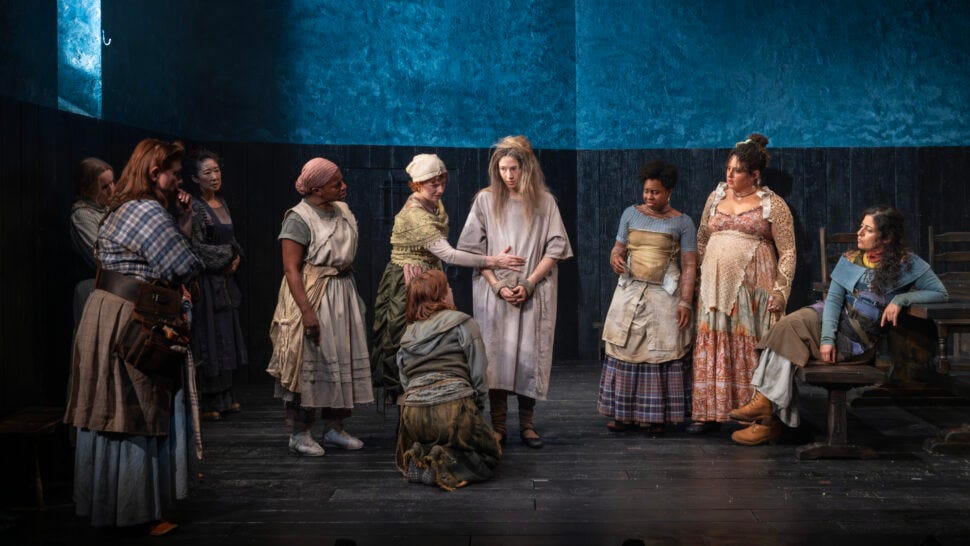
Where Mary Jane runs cool, The Welkin (written by Lucy Kirkwood and directed by Sarah Benson) runs hot. The Welkin takes place in rural England in 1759, where young Sally Poppy is on trial for assisting a man in murdering a little girl. As her plea, Sally claims she’s pregnant, which would commute her sentence. As a result, twelve village women are charged with determining whether or not Sally is pregnant.
The Welkin… it’s giving The Crucible meets Twelve Angry Men: Feminist Edition.
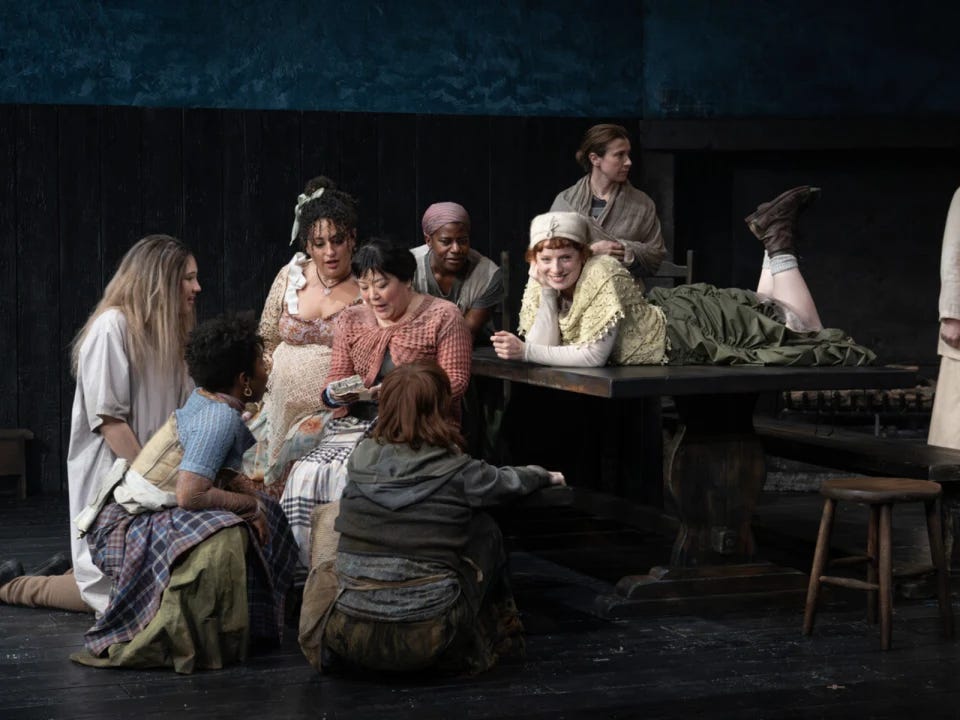
Like Mary Jane, The Welkin pits its female-identifying characters against an established institution: here, the legal system rather than the medical system. Like Mary Jane, The Welkin also illuminates the invisible labor performed by women in domestic spheres. Most of The Welkin’s female jurors want to reach a decision quickly in order to go home: to finish the laundry, churn the butter, and tend their crops.
But while Mary Jane demonstrates the heroism of a calm, cool, collected woman, The Welkin highlights the power of a feral, bloody, unhinged woman. Contrasting the blue hues and cold temperatures of Mary Jane, The Welkin is splattered with red-hot imagery: blood sacrifices, the fiery blaze of Halley’s comet, and a fireplace spitting demonic— or is it angelic? — ash. One of the production’s most crackling moments occurs when the male bailiff, who is tasked with bearing witness to the proceedings but must not speak, tries to interject. Elizabeth Luke, played by a brilliant Sandra Oh, cuts him off: “You are not to speak. It is time for you to be silent and listen.” Here, Kirkwood’s line is not subtle and does not need to be, because it is pushing back against years of history.
Throughout the play, Kirkwood’s female characters repeatedly reject every conceivable feminine stereotype. These women are not martyrs, saviors, victims, or seductive devils. For instance, the murderous Sally insists that she is an active agent in the harm she perpetuates, not merely a woman under the control of a man she loves. Similarly, Elizabeth insists that her desire to defend Sally is the result of rational thought, rather than the product of maternal instinct.
Elizabeth urges her fellow jurors to think for themselves. She does not want them to simply replicate the structure and mechanics of a system designed by men, but instead to reimagine the entire system through a feminine perspective.
Thankfully, The Welkin does just that.
Mary Jane mirrors its protagonist by exhibiting maternal care and restraint. By contrast, The Welkin mirrors its characters through sheer absurdism. The play is chaotic, careening, and— dare I say it— unmanned. The Welkin drops tantalizing anachronistic hints (“What’s an airplane?”), employs choice contemporary swear words (“F***ing C***t”), and drops a plaintive a cappella pop ballad (“Just another Manic Monday”). In its blood-soaked, reckless, profane exuberance, The Welkin insists: let women be baffling.
I left The Welkin in a giddy delirium. I want to be everything. I want to blow hot and cold. I want riotous happiness in the midst of maddening grief, because god forbid a woman hold fast to her Great Mystery. God forbid a woman swell to encompass contradiction or rise to wield the full spectrum of her power. God forbid a woman— onstage or off— refuse to beat people over the head with the kind of moral obviousness that stems from occupying center at all times.
I don’t want more plays written by women just to have more plays written by women. I want more plays written by women because I think a woman’s perspective elevates the freaking form by interrogating crucial aspects of the human condition and by envisioning alternative futures.
Please support women’s art because the answers are here: in the kind of underworld we’ve learned to live in, and the kind of otherworld we can create.
Take Mary Jane and The Welkin as blazing examples: these aren’t shootouts or shouting matches. These ain’t no cowboy pictures. In Mary Jane and The Welkin, there aren’t “good guys” and “bad guys.” There are just women: imperfect, grotesque, thrilling, radiant, spiteful, hopeful, complicated women… who have work to do.
If you enjoy my writing, go wild and click the ❤️ or 🔄 button on this post so more people can discover it on Substack. Thank you to my theatergoing companions: Alan, Dani, Lilly, Ellen, Lauren, Ben, and Max. Thank you Max for encouraging me to be anything and everything.
ilana
a being
place
is certainly
the place
to be
!!!!!!!!
The way you take in art, and the way you integrate art into life and life into art, is absolutely exquisite. And your entire spectrum of being, is *pauses really takes it in, awe comes over his face* sorry I forgot what I was going to say